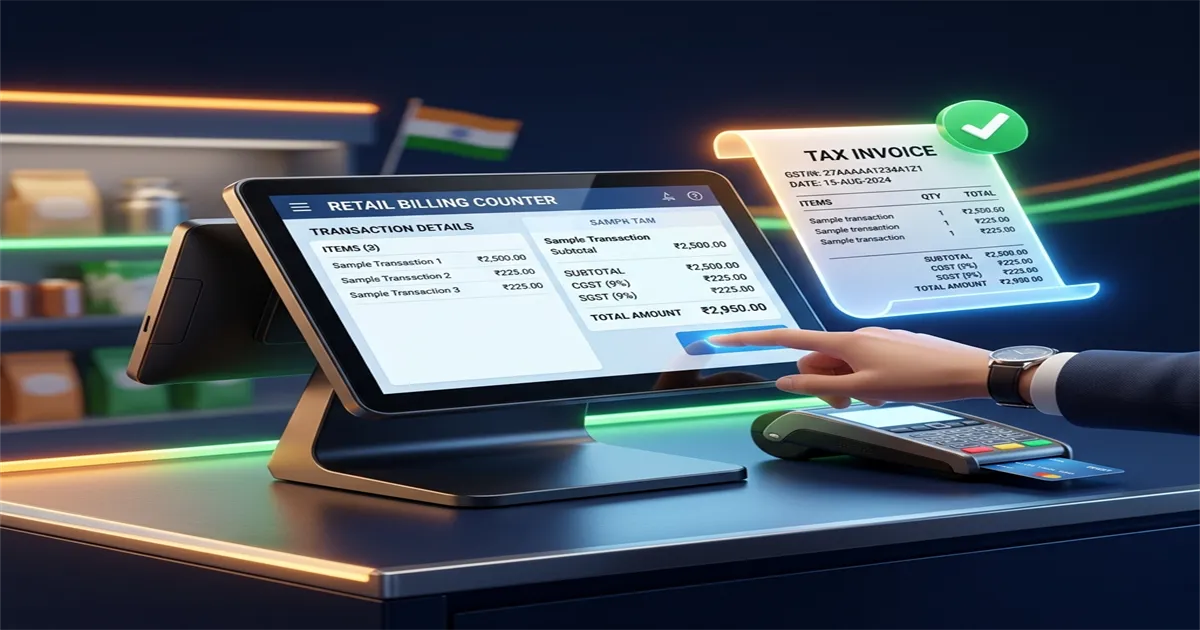
GST compliance for Indian retail stores is more involved than it looks. On the surface, it's adding a tax percentage to each bill. In practice, it means tracking CGST and SGST for intra-state sales, IGST for inter-state sales, applying the correct HSN code to each product category, generating GSTR-1 and GSTR-3B reports for monthly or quarterly filing, and issuing e-way bills for high-value goods movements.
Most small retail store owners in India use a combination of manual invoices and a basic billing software — and discover the gaps only when their chartered accountant asks for GST reports and the data isn't there.
This guide explains what GST billing software for retail stores must handle in 2026 and what to look for when choosing one.
What GST Compliance Requires for Indian Retail Stores
CGST, SGST, and IGST
When a retail store sells to a customer in the same state, the GST is split equally into CGST (Central GST) and SGST (State GST). For example, an 18% GST on a sale would be 9% CGST + 9% SGST. When the customer is in a different state (inter-state sale), the entire amount is collected as IGST. Your billing software must determine which applies automatically based on seller and buyer state — and show both amounts separately on the invoice.
HSN Codes
Every product in India has a Harmonized System of Nomenclature (HSN) code that determines its GST rate. Optical frames are HSN 9004 (12% GST). Gold jewelry is HSN 7113 (3% GST). Cosmetics are HSN 3304 (18% GST). Your POS must allow you to assign the correct HSN code per product and apply the correct tax rate automatically at billing.
GST-Compliant Invoice Format
A valid GST invoice in India must include: your GSTIN, the buyer's GSTIN (for B2B), invoice number, invoice date, HSN code per line item, taxable value, CGST/SGST or IGST amount per item, and total invoice value. Missing any of these makes the invoice non-compliant and means the buyer cannot claim input tax credit.
GSTR-1 Filing
GSTR-1 is the monthly or quarterly return of all outward supplies (sales). Your billing software must be able to export all B2C sales grouped by tax rate, and all B2B sales with buyer GSTIN, for the filing period. The export must be in the format acceptable to the GST portal — JSON or Excel.
GSTR-3B Filing
GSTR-3B is the summary return filed monthly showing total tax collected and input tax credit claimed. Your billing software should generate a GSTR-3B summary from your sales data — total taxable value, total CGST, total SGST, total IGST, broken out by tax slab (5%, 12%, 18%, 28%).
What to Look For in GST Billing Software for Retail in 2026
1. Automatic CGST/SGST/IGST Determination
The software should automatically determine whether a sale is intra-state or inter-state based on the seller's registered state and apply CGST+SGST or IGST accordingly. You should not have to manually select the tax type at billing.
2. Product-Level HSN Code Assignment
You should be able to assign an HSN code and corresponding GST rate to each product in your catalog. The system should apply the correct rate automatically when that product is billed — not require the cashier to manually enter the tax percentage.
3. GSTR-1 and GSTR-3B Report Export
The software must generate GSTR-1 data in a format that can be uploaded directly to the GST portal — either JSON file or Excel in the standard format. GSTR-3B summary should also be exportable with the tax liability calculation done automatically.
4. Mobile Billing
Small retail stores in India increasingly bill on smartphones and tablets. GST billing software that runs as a native Android or iOS app — rather than requiring a dedicated Windows computer — reduces hardware cost significantly and allows billing from anywhere in the store.
5. WhatsApp Invoice Delivery
In India, WhatsApp is the standard for sharing invoices with customers. GST billing software that can send a digital invoice directly via WhatsApp at the time of billing eliminates the cost of thermal paper and creates a digital paper trail for the customer.
6. Multi-Tax Rate Support
If your store stocks products across multiple categories — for example, a gift shop selling cosmetics (18% GST), packaged foods (12% GST), and handmade items (0% or 5% GST) — the software must support multiple tax rates in the same invoice automatically.
RetaPOS GST Billing for Indian Retail Stores
RetaPOS is built for the Indian retail market and includes full GST compliance out of the box:
- Automatic CGST/SGST (intra-state) and IGST (inter-state) calculation
- HSN code assignment per product with correct GST rate auto-applied at billing
- GST-compliant invoice format with GSTIN, HSN codes, and tax breakdown
- GSTR-1 export in JSON and Excel format for GST portal upload
- GSTR-3B summary report with tax liability calculation
- WhatsApp invoice delivery at checkout — no thermal paper required
- Multi-tax rate support — mix different GST rates in the same bill
- Runs on any Android or iOS smartphone — ₹6,000/year, all features included
- 30-day money-back guarantee — test it with your own data
Common GST Billing Mistakes Indian Retailers Make
- Wrong HSN code: Assigning a generic HSN code to all products instead of the correct code per category leads to incorrect tax rates and GST notices
- Mixing CGST/SGST and IGST: Applying CGST+SGST to inter-state sales (or vice versa) is a compliance error that can trigger scrutiny
- Missing invoice fields: GST invoices missing GSTIN or HSN codes make it impossible for B2B customers to claim input tax credit
- Manual GSTR filing without software export: Manually entering every sale into the GST portal is error-prone and time-consuming — billing software with GSTR export eliminates this
- Not tracking B2B vs B2C separately: B2B sales (to registered businesses) and B2C sales (to end consumers) are reported differently in GSTR-1
Bottom Line
GST billing software for Indian retail stores in 2026 must handle CGST/SGST/IGST automatically, assign HSN codes per product, generate GSTR-compliant reports, and work on a smartphone. RetaPOS handles all of this at ₹6,000/year with unlimited users — no additional accounting software needed.