Managing an optical or eye-wear retail store is more complex than most retail categories. You need to track prescriptions per customer, manage lens lab orders, maintain separate frame and lens inventory, and send timely eye checkup reminders — all while generating GST-compliant invoices in India or VAT-compliant invoices in UAE and UK.
Choosing the wrong POS creates real problems: billing errors, stock discrepancies between frames and lenses, and customers who never return because no one followed up on their annual eye exam.
This guide covers what to look for in an optical store POS in 2026, which features matter most, and how the leading options compare.
What Makes an Optical Store POS Different
A generic retail POS tracks products and processes payments. An optical-specific POS needs to do significantly more:
- Prescription tracking: Store sphere, cylinder, axis, addition, and pupillary distance per customer per visit — and recall this instantly at the next purchase
- Lens lab order management: Track orders sent to the lens lab, expected delivery dates, and status updates
- Frame and lens inventory separately: Frames and lenses are different SKU types with different pricing logic
- Eye checkup reminders: Automated reminders to customers when their annual eye exam is due (typically 12 months after the last visit)
- Power-wise product filtering: When a customer with a known prescription walks in, the system should surface the frames compatible with their power range
- GST/VAT compliant invoicing: Optical products fall under specific HSN codes in India; VAT must be applied at the correct rate in UAE and UK
Key Features to Look For in 2026
1. Prescription Management
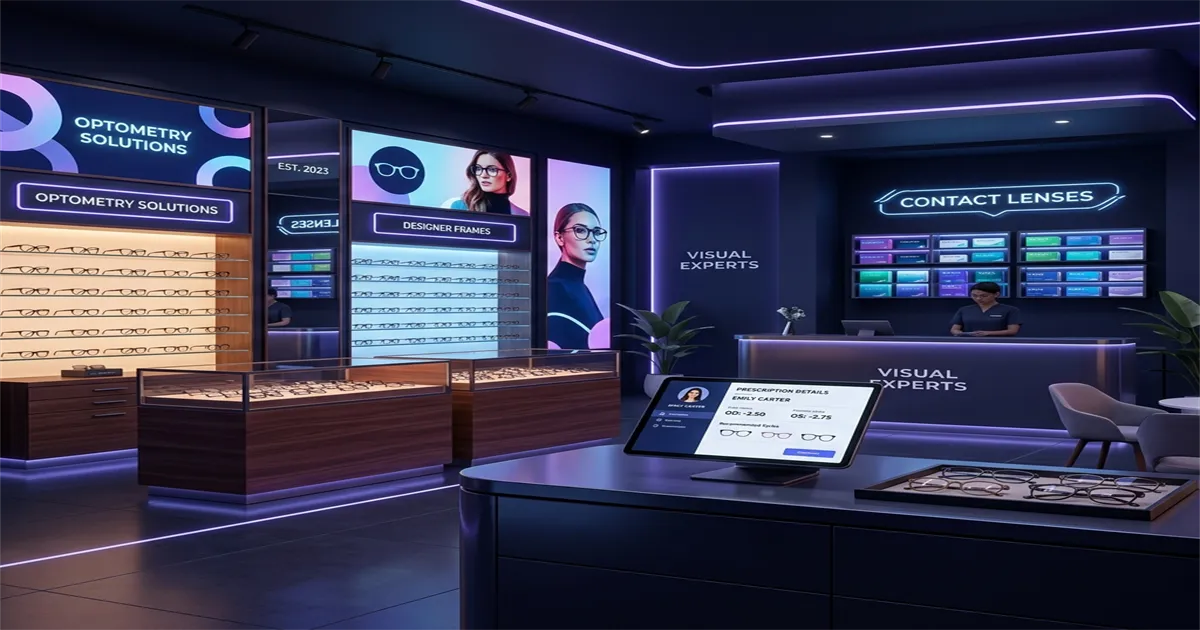
Every customer's prescription details should be stored in their CRM profile and auto-filled at billing. The system should track prescription history over multiple visits so you can identify customers whose power has changed significantly. Look for a POS that stores full binocular prescription data — both eyes, sphere, cylinder, axis, addition — not just a notes field.
2. Lens Lab Integration
Most optical stores don't stock every lens combination — they send orders to a lens lab for custom grinding. Your POS should let you create and track lens lab orders linked to specific customer bills, track expected delivery, and alert you when an order is ready for pickup.
3. Inventory for Frames and Lenses
Frames are tracked by brand, model, color, and size. Lenses are tracked by type (single vision, bifocal, progressive), material, and coating. A POS that treats both as generic "products" will create inventory chaos. Look for a system that handles both inventory types with appropriate attributes.
4. WhatsApp CRM for Follow-Ups
Eye checkup reminders sent via WhatsApp have far higher open rates than SMS or email. In India, UAE, and Southeast Asia, WhatsApp is the primary communication channel. A POS with built-in WhatsApp integration can automatically send annual checkup reminders, new collection announcements, and loyalty offers without manual effort.
5. GST / VAT Billing
In India, optical products (frames, lenses, contact lenses) have different GST rates. Frames are typically 12% GST; contact lenses are 12%; sunglasses may be 18%. Your POS must support HSN-code-based tax rates and generate GSTR-1 and GSTR-3B compliant reports. In the UAE and UK, VAT at 5% and 20% respectively must be calculated correctly and reflected on VAT-compliant invoices.
6. Mobile-First Operation
Many optical stores have compact floor space. A POS that runs on a smartphone or tablet eliminates the need for a dedicated counter-top terminal. Staff can assist customers on the floor, look up prescriptions, and process payments from anywhere in the store.
RetaPOS for Optical Stores
RetaPOS includes purpose-built features for optical and eye-wear retailers:
- Full prescription tracking (sphere, cylinder, axis, addition, PD) per customer profile
- Lens lab order management with status tracking
- Separate frame and lens inventory with power-based filtering
- Automated WhatsApp eye checkup reminders
- GST-compliant invoicing for India with HSN codes and GSTR reports
- VAT-compliant invoicing for UAE (5%) and UK (20%)
- Loyalty points and birthday/anniversary offers via WhatsApp
- Runs on any Android or iOS smartphone — no dedicated hardware
- US$399/year (International) or ₹6,000/year (India) — all features included
Explore the full RetaPOS Optical Store POS feature set →
What to Ask When Evaluating Any Optical POS
- Can it store full binocular prescription data and recall it at future visits?
- Does it manage lens lab orders separately from retail inventory?
- Can it track frames and lenses as distinct product types with their own attributes?
- Does it support GST/VAT billing with the correct rates for optical products?
- Does it send automated customer follow-up reminders via WhatsApp?
- Can it run on a smartphone without dedicated POS hardware?
- Is pricing transparent — all features included, no per-transaction fees?
Bottom Line
The best POS for an optical store in 2026 is one that handles prescription management, lens lab orders, and frame-lens inventory as first-class features — not afterthoughts built on top of a generic retail system. It should generate GST or VAT invoices correctly, integrate with WhatsApp for customer follow-ups, and run on the device your staff already has.
RetaPOS was built specifically for these requirements. Request a free demo to see the optical POS in action.