Cloud kitchens (delivery-only brands) and quick service restaurants (QSRs) have a different operating reality from a sit-down restaurant. There's no table service and often no walk-in counter at all — orders pour in from multiple delivery aggregators at once, every ticket has to hit the kitchen accurately and fast, and a single missed or wrong order means a refund and a bad rating.
A generic retail POS — or even a basic restaurant POS — struggles here. This guide covers what a cloud kitchen or QSR needs from a POS in 2026 and how to evaluate the options.
What Makes Cloud Kitchen & QSR POS Different
- Multi-channel orders: Orders arrive from several delivery platforms plus your own website or phone — all need to land in one screen, not five
- Speed over everything: The gap between order received and food out the door is the core metric; the POS must not slow it down
- Kitchen-facing workflow: Tickets must reach the prep line clearly — printed KOTs or a kitchen display screen, not a cashier reading orders aloud
- Tight food costing: Margins are thin; you need accurate cost-per-dish and live raw-material deduction
- Menu by brand and time: One kitchen may run several virtual brands and switch menus by daypart (breakfast vs late-night)
- Tax compliance: India GST on restaurant services and UAE 5% VAT must be applied and reported correctly
Key Features to Look For
1. Online Order Aggregation
The POS should consolidate orders from every delivery channel and your direct orders into one queue. Staff accept, prep, and dispatch from a single screen instead of toggling between tablets. Look for a system that timestamps each order so you can track prep-time performance per channel.
2. Kitchen Order Tickets (KOT) and Kitchen Display
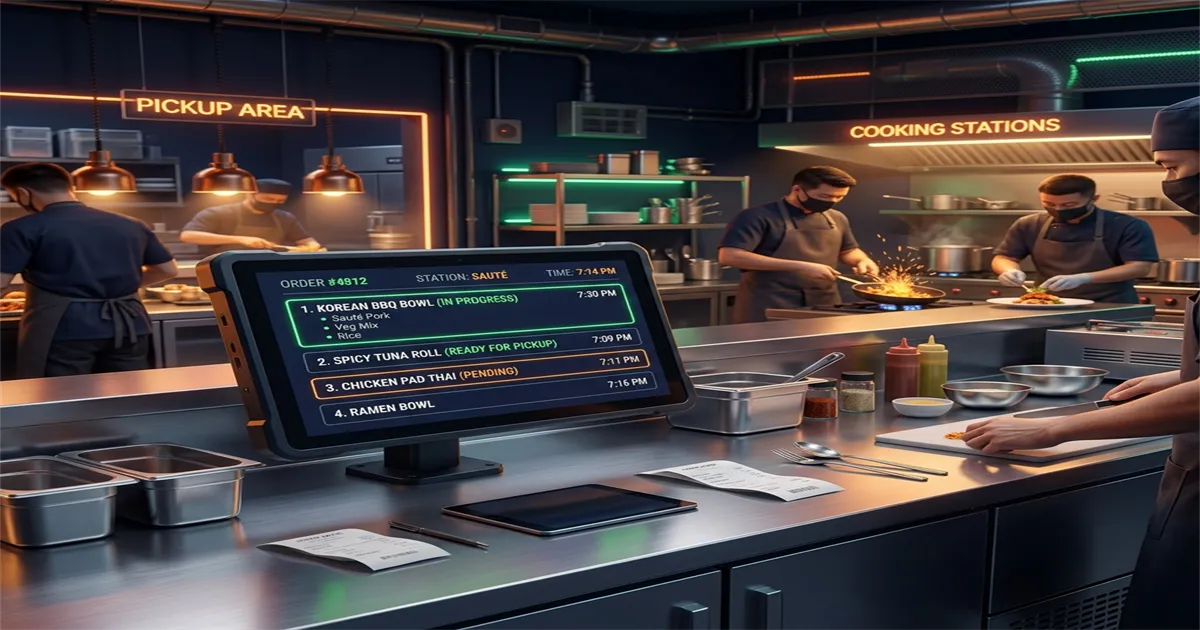
Every accepted order should generate a KOT that prints at the prep station or appears on a kitchen display screen. Items should be markable as "in progress" and "ready" so the line and the dispatch point stay in sync. This is the single biggest driver of order accuracy in a high-volume kitchen.
3. Recipe Costing and Live Inventory Deduction
Each menu item should be linked to its recipe ingredients. When a dish sells, the POS deducts the raw materials (buns, patties, sauces, packaging) from inventory in real time — giving you accurate food cost percentage and an early warning before you run out of a key ingredient mid-rush.
4. Multi-Brand and Daypart Menus
A cloud kitchen often runs multiple virtual brands from one location. The POS should let you maintain separate menus per brand and switch availability by time of day, so a sold-out item or a breakfast-only menu is reflected everywhere instantly.
5. WhatsApp Order Confirmation and Direct Ordering
For direct (non-aggregator) orders, WhatsApp is the cheapest and most-used channel in India, the UAE, and Southeast Asia. A POS that confirms orders and sends "your order is out for delivery" updates via WhatsApp builds a direct customer base you don't pay commission on.
6. GST / VAT Billing
In India, restaurant service attracts GST (commonly 5% without input credit for standalone outlets) and the POS must generate compliant bills and GSTR reports. In the UAE, prepared food and delivery are standard-rated at 5% VAT — invoices must show VAT broken out per FTA rules.
RetaPOS for Cloud Kitchens and QSRs
RetaPOS includes features built for high-volume, delivery-first food operations:
- Consolidated order queue for online and direct orders
- Kitchen Order Ticket (KOT) generation and kitchen display workflow
- Recipe costing with live raw-material deduction at each sale
- Multi-brand menus and daypart availability control
- Combo and set-meal billing with component-level inventory
- WhatsApp order confirmations and delivery-status updates
- GST billing for India with GSTR export; UAE 5% VAT invoices
- Live sales dashboard — track orders per hour and per brand from your phone
- Runs on any Android or iOS smartphone — US$399/year (International) or ₹6,000/year (India), all features included
Explore the full RetaPOS Cloud Kitchen POS →
Questions to Ask Before Choosing a Cloud Kitchen / QSR POS
- Does it consolidate orders from multiple channels into one screen?
- Does it generate KOTs and support a kitchen display?
- Does it deduct raw materials live via recipe costing?
- Can it run multiple virtual brands and daypart menus from one kitchen?
- Does it confirm and update direct orders over WhatsApp?
- Does it handle India GST / UAE VAT billing and reports?
- Is pricing flat with no per-order or per-transaction fee?
Bottom Line
The best cloud kitchen and QSR POS in 2026 keeps every order in one queue, drives the kitchen with KOTs or a display screen, and tracks food cost in real time — while handling GST or VAT correctly. RetaPOS does all of this in one mobile app at a flat annual fee with no per-order charges. If you also run a dine-in café or bakery, see our bakery & café POS guide.